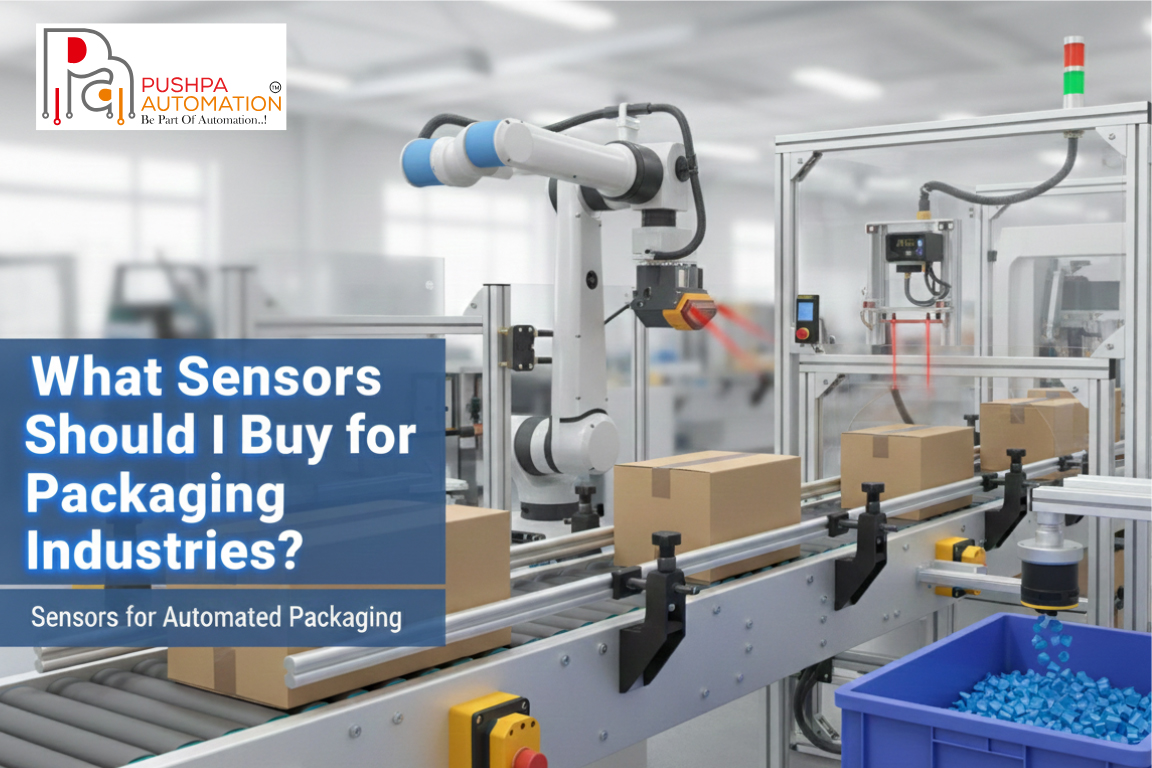
Packaging Automation is no longer a choice, it is a necessity for companies that want to enhance the efficiency, precision, and quality of their products. In many sectors, such as food and beverage, pharmaceuticals, FMCG, cosmetics, and industrial products, packaging Industries are mostly dependent on sensors to operate in a smooth and steady manner.
The most widespread question that is put across by plant managers and buyers of automation is: What sensors do I need to purchase for packaging Industries or lines? The solution is based on your product type, packaging rate, environment, and quality requirements.
At Pushpa Automation, the designs and integration of packaging lines are done with the appropriate mix of sensors to achieve reliability, safety, and a long life cycle.
This detailed guide explains the kind of sensors deployed in a packaging line, the applications and how to ensure that you have the correct sensors to use in your automation process.
The basic elements enabling the use of packaging machines on an automatic basis are sensors. They keep checking the products, the movements of the machines and process conditions and reporting real-time feedback to the control system.
Sensors are used in a modern packaging line to assist in:
The lack of appropriate sensors would ruin even the most sophisticated packaging machines with frequent errors, inconsistency of the output, and increased maintenance.
Sensing technologies are different in different stages of a packaging line. The most prevalent sensors of packaging automation, together with their applications, are listed below.
Best in: Product sensing, product detection, and product presence.
A A Photoelectric sensors are considered to be the most popular sensors in a packaging line. They operate based on the emission of a beam of light and detecting variations when an object breaks or bounces off the beam of light.
Photoelectric sensors feature in a standard selection option within the packaging lines, coupled by Pushpa Automation due to their uniqueness in terms of adaptability to the various industries in which they are reliable.
Application: The most suitable is machine position sense and metal detection. A Proximity sensors are able to sense objects without touching them. Packaging machines usually incorporate inductive proximity sensors to identify metallic parts.
The proximity sensors assist in ensuring that the automated packaging systems operate smoothly and precisely in terms of mechanical functioning.
Best In: Inspecting, verifying and quality control.
Vision sensors are cameras with image processing software that check packaging live. There has been a growing significance of these systems because of tightened quality and traceability requirements.
Vision system is particularly important in food, pharmaceutical and export-oriented packaging Industries designed by Pushpa Automation.
Best: It is best at colour recognition and print mark recognition.
Colour sensors identify certain colours or colour variations on packaging materials and products.
The colour sensors are typically applied in the flexible packaging, printing and labelling processes.
Best to use: Transparent Objects and the level detector of liquids.
Unlike optical sensors, ultrasonic sensors also eliminate the need to use light, and hence they are appropriate in cases where the optical structures may not work.
Best use: Glass fragments and broken containers can be detected.
Specialised inspection sensors that detect any glass contamination, cracks, or glass breakage are called glass detection sensors and are used in packaging industry lines. These types of sensors are essential in those industries where it is required to use glass containers and the safety of products is important.
Glass detectors are needed in beverage, food, and pharmaceutical lines, which deal with glass packages.
Best if: Sensing plastic contamination and damaged plastic parts.
To identify unwanted plastic fragments, incorrect plastic materials or damaged plastic components, plastic detection sensors are used in packaging lines. The sensors particularly matter when it comes to food and pharmaceutical, and industrial packaging, where contamination of plastic or any defects may compromise the quality and safety of the products.
Food processing, pharmaceutical, as well as industrial packaging lines use plastic detection sensors to ensure safety and quality standards are upheld.
To choose the appropriate sensors, one needs to know their application and the environment in which they will be used.
At Pushpa Automation, the selection of sensors is always in accordance with the production objectives of the customer and the long-term reliability.
The Advantages of using the appropriate sensors in the long run are:
The majority of Fully Automatic Packaging industry lines are operated with a combination of sensors in collaboration:
This combined strategy guarantees efficient functioning, reduced downtime, and the quality of output.
The packaging lines require the proper selection of sensors to ensure efficient and safe packaging lines, as well as high-quality packaging operations of the package. Sensors allow packaging machines to be used in harsh industrial conditions, as the devices can be depended upon to detect the simplest products all the way to implementing advanced safety and inspection systems. When sensors are chosen correctly, and the system is integrated, Pushpa Automation can offer the solution in the form of packaging that provides manufacturers with an opportunity to increase their productivity, minimise downtime, and provide the same quality of packaging for all industries.
Photoelectric, proximity, vision, ultrasonic, glass, and plastic detection sensors.
Photoelectric sensors are best for fast and accurate detection.
They improve accuracy, safety, speed, and reduce downtime.
Ultrasonic sensors are ideal for transparent containers.
Yes, especially when glass containers are used for safety compliance.
Inductive proximity sensors detect machine parts and movements.
Yes, automatic packaging lines use multiple sensors together.
They reduce errors, wastage, and unplanned stoppages.
System integrators like Pushpa Automation help select sensors based on application and line requirements.
Top automation companies in Mumbai, India, include Pushpa Automation, known for industrial and packaging automation with advanced sensor-based solutions.
 What
Are the Best Non-Ferrous Proximity Sensors for Detecting Aluminium?
What
Are the Best Non-Ferrous Proximity Sensors for Detecting Aluminium?
 What
Are the Best Non-Ferrous Proximity Sensors for Detecting Aluminium?
What
Are the Best Non-Ferrous Proximity Sensors for Detecting Aluminium?
 How Sensors Work
and Their Importance in Today’s World
How Sensors Work
and Their Importance in Today’s World
 Top Benefits
of Using Encoders in Industrial Automation
Top Benefits
of Using Encoders in Industrial Automation
 What Are Plastic Detection Sensors and How Do
They Work?
What Are Plastic Detection Sensors and How Do
They Work?


 Download Brochure
 Home
Home